
The Minister of Agriculture has gazetted the Routine Vaccination Scheme for Foot-and- Mouth Disease under Section 101 of the Animal Diseases Act2. The scheme was published on 4 May 2026 and came into effect on that date.
This document explains what the scheme means, what it requires, and what still needs to happen before owners can formally participate.
What the scheme is
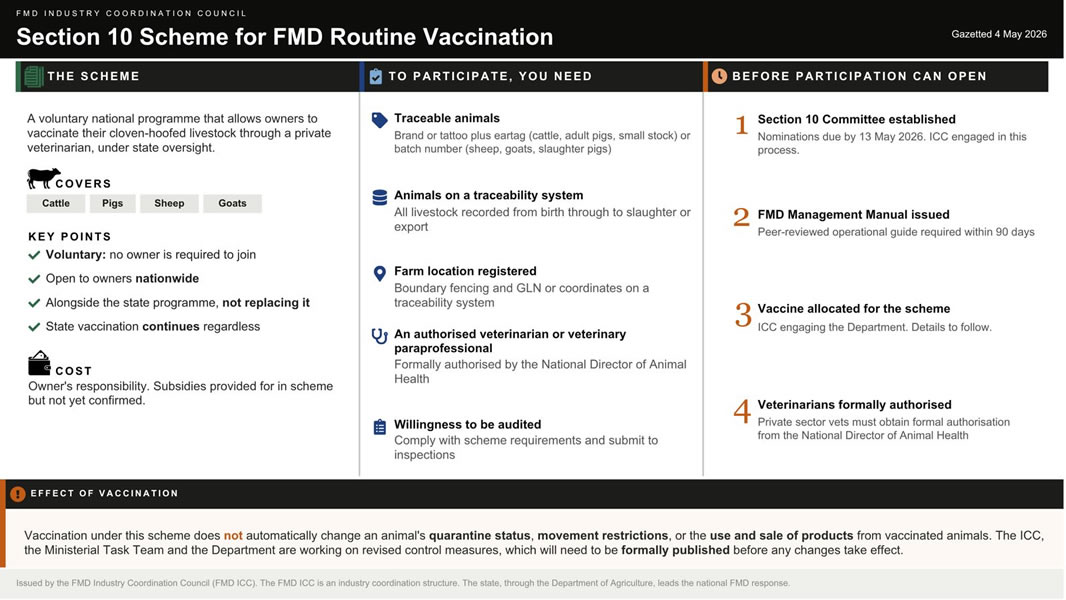
The Routine Vaccination Scheme for FMD is a national programme under the Animal Diseases Act2. It allows owners of domesticated cloven-hoofed livestock3 to vaccinate their animals through a private veterinarian4, under the oversight of state veterinary services5.
- The scheme covers cattle, pigs, sheep and goats. It is open to owners nationwide.
- Participation is voluntary. No owner is required to join.
- The scheme runs alongside the state vaccination programme. It does not replace it.
- Owners who do not participate are still eligible to receive vaccination through state veterinary services5 if prioritised as part of the national strategy.
Requirements to participate
- Traceable animals. All livestock must be permanently identified, branded or tattooed, and in the case of cattle, adult pigs and small stock, fitted with an eartag7. Sheep and goats require a batch number recorded on a traceability system8.
- Animals recorded on a traceability system8. All livestock must be recorded on a system that tracks animals from birth through to slaughter or export.
- Farm location registered. Your farm or property must have a defined location with a GLN9 or coordinates, registered on a traceability system8.
- An authorised veterinarian or veterinary paraprofessional4. You must appoint someone who has been authorised by the National Director of Animal Health10 to conduct veterinary acts under the scheme. The ICC has requested a list of authorised private sector professionals and will communicate it once received.
- Willingness to be audited. Owners agree to comply with the scheme’s requirements and submit to audits and inspections.
Cost of participation
Vaccine and vaccination costs are the responsibility of the animal owner. The scheme also provides for the possibility of subsidies, cost-sharing arrangements and phased implementation to support broader participation, but the details of these have not yet been confirmed.
Sourcing vaccine
The specific process for sourcing vaccine under the scheme, including which suppliers are approved and how to order, will be confirmed once the Section 10 Committee12 is formally established.
Vaccine must come from a licensed manufacturer, importer or distributor, and must be administered under the oversight of your appointed veterinarian.
What still needs to happen before participation opens
The scheme is legally in force, but four things still need to happen before owners can formally participate.
1. The Section 10 Committee12 must be established
The scheme requires the Minister to appoint a Committee12 to oversee implementation. This Committee will advise on approved vaccines, set the detailed participation requirements, and recommend to the Director of Animal Health that Certificates of Participation13 be issued to qualifying owners. Nominations are due to be submitted by 13 May 2026, and the ICC is engaged in this process.
2. The FMD Management Manual16 must be issued
The National Director of Animal Health10, after consultation with the Committee12, must issue the FMD Management Manual16. It will set out the step-by-step requirements for participating owners and their appointed veterinarians or veterinary paraprofessionals, covering vaccination procedures, record-keeping, biosecurity requirements, post-vaccination surveillance and inspection checklists. All role players are committed to issuing this as soon as possible.
3. Vaccine must be allocated for use under the scheme
4. Private sector veterinarians and veterinary paraprofessionals must obtain formal authorisation
Effect of vaccination
Vaccination under this scheme does not automatically change an animal’s quarantine status, movement restrictions, or the use and sale of products from vaccinated animals. These aspects fall outside the scope of Section 10 of the Animal Diseases Act and are not regulated by this scheme. The ICC, the Ministerial Task Team and the Department are working on revised control measures to address these matters. These control measures will need to be formally published before vaccinated animals, whether vaccinated by the state or through this scheme, are treated differently for movement and trade purposes.
How to prepare if you want to participate
- Confirm that all your cloven-hoofed livestock carry a permanent identification mark6 (a brand or tattoo). Cattle, adult pigs and small stock must also have an eartag7. Sheep, goats and slaughter pigs must have a batch number recorded on a traceability system8.
- Confirm that all your livestock are recorded on a traceability system8.
- Confirm that your property has defined boundary fencing and that its location is registered with a GLN9 or location coordinates on a traceability system8.
- Contact a veterinarian to confirm whether they are authorised by the National Director of Animal Health10 to operate under the scheme.
- Continue working with state veterinary services5 as normal. The state vaccination programme continues regardless of whether you participate.
Responsibilities of your appointed veterinarian or veterinary paraprofessional
Once participation opens, your authorised veterinarian or veterinary paraprofessional4 will be responsible for:
- Receiving vaccine from approved suppliers and managing cold chain requirements11
- Overseeing correct vaccination technique
- Post-vaccination surveillance14 and reporting
- Reporting any suspected FMD cases to the state veterinarian5 immediately
- Providing a biosecurity plan15 for your operation
- Record-keeping and reporting to the Committee12
Proof of vaccination
Animals will be certified as vaccinated and having a valid vaccination status for as long as their vaccination record is up to date on the traceability system8. Owners also receive a Certificate of Participation13 from the Director of Animal Health.
State vaccination continues
The state vaccination programme continues in FMD-infected and high-risk areas. Owners in those areas continue to receive vaccination through state veterinary services5 as part of the national strategy, regardless of whether they participate in the scheme.
Definitions
1 Section 10 of the Animal Diseases Act A provision of the Animal Diseases Act that authorises the Minister of Agriculture to establish health schemes for controlled animal diseases. The Routine Vaccination Scheme for FMD was established under this provision.
2 Animal Diseases Act The Animal Diseases Act, 1984 (Act No. 35 of 1984) is the primary South African legislation governing the control of animal diseases. It gives the State authority over disease control measures, including movement control, vaccination and animal health schemes.
3 Domesticated cloven-hoofed livestock Cattle, pigs, sheep and goats kept as livestock.
4 Authorised veterinarian or veterinary paraprofessional A veterinarian or veterinary paraprofessional who has been specifically authorised by the National Director of Animal Health to conduct veterinary acts under the scheme, and appointed by the owner. Not all private veterinarians are automatically authorised.
5 State veterinary services Veterinary services provided by the government through the Department of Agriculture and provincial authorities. State veterinarians are responsible for disease control, vaccination in high-risk and infected areas, and oversight of animal health under the Animal Diseases Act.
6 Permanent identification mark A brand or tattoo applied directly to an animal to permanently identify it. This is a requirement for all cloven-hoofed livestock participating in the scheme.
7 Eartag A tag attached to an animal’s ear carrying a unique identification number. Under the scheme, cattle, adult pigs and small stock must each have an individual eartag in addition to a permanent identification mark.
8 Traceability system A system that records and tracks animals and animal products throughout their entire life cycle, from birth through ownership changes and movements to slaughter or export. All animals and farm locations must be registered on a traceability system to participate in the scheme.
9 GLN (Global Location Number) A standardised, unique number that identifies a specific physical location such as a farm or property. Under the scheme, each participating property must have a GLN or location coordinates registered on a traceability system.
10 National Director of Animal Health The senior official within the Department of Agriculture responsible for animal health in South Africa under the Animal Diseases Act. This person authorises veterinarians to conduct veterinary acts under the scheme and issues Certificates of Participation to qualifying owners.
11 Cold chain management The process of keeping vaccines at the correct temperature from manufacture through to the point of use. FMD vaccines must be stored and transported within specified temperature ranges. Failure to maintain the cold chain can reduce vaccine effectiveness. Under the scheme, the appointed veterinarian or veterinary paraprofessional is responsible for cold chain management.
12 Section 10 Committee The expert oversight body appointed by the Minister to coordinate and govern the scheme. Members include a representative from the Department of Animal Health, a state veterinarian, veterinarians from the cattle stud, dairy and feedlot industries, and FMD experts from the Agricultural Research Council and the University of Pretoria. The Committee advises the Director of Animal Health on vaccine approval, participation certificates and operational requirements.
13 Certificate of Participation A certificate issued by the Director of Animal Health confirming that an owner formally participates in the scheme. Participation begins on the date this certificate is issued. Individual animals are certified through their vaccination records on the traceability system.
14 Post-vaccination surveillance Monitoring carried out after vaccination to confirm that animals have responded to the vaccine and to detect any adverse reactions or signs of disease. Under the scheme, this is a responsibility of the appointed veterinarian or veterinary paraprofessional.
15 Biosecurity plan A written plan setting out the measures an owner will take to prevent the introduction and spread of disease on their property. Under the scheme, the appointed veterinarian or veterinary paraprofessional must provide a tailored biosecurity plan for each property. The owner is responsible for putting it into practice.
16 FMD Management Manual A peer-reviewed guide issued by the National Director of Animal Health, after consultation with the Section 10 Committee, designed to educate and empower owners of animals participating in the scheme. It will set out the step-by-step requirements for participating owners and their appointed veterinarians or veterinary paraprofessionals, covering vaccination procedures, record-keeping requirements, biosecurity requirements, post-vaccination surveillance obligations and inspection checklists. The scheme requires this manual to be issued within 90 days of the scheme coming into force.